
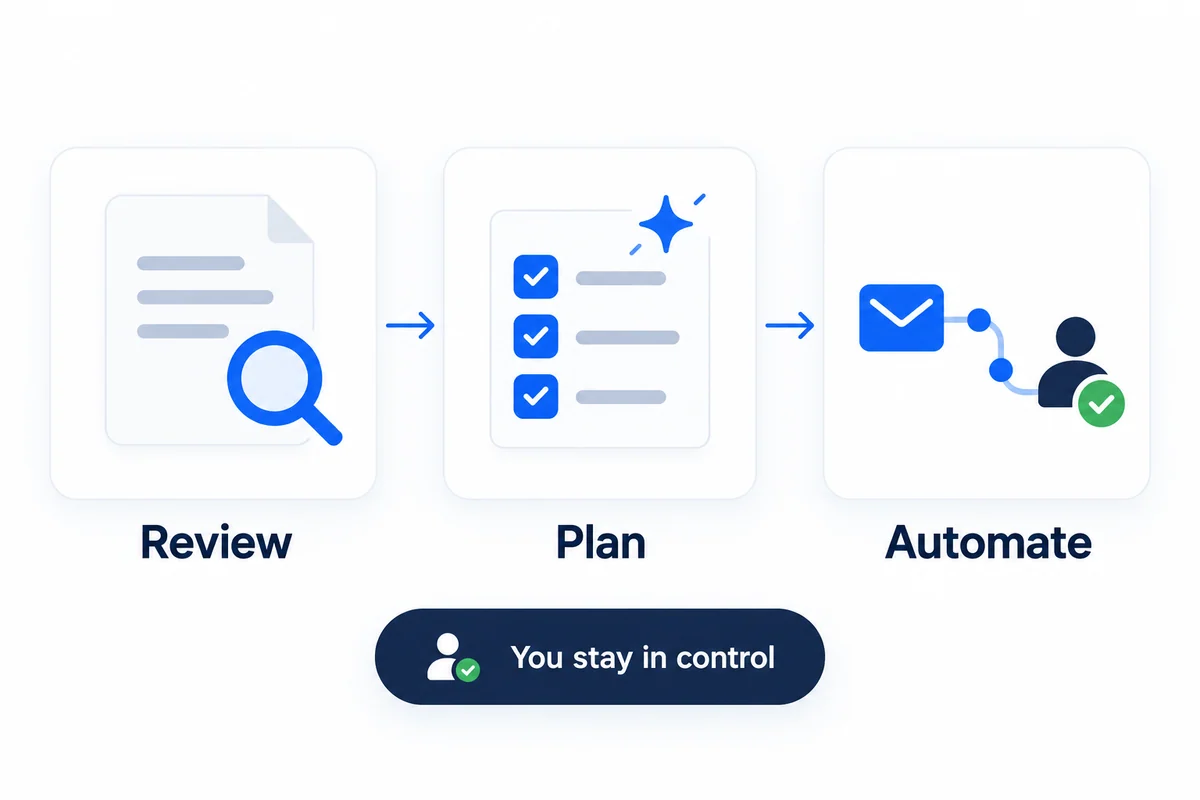
The useful starting points
- Ask for a plan tied to a real business task, with a clear owner and next step.
- Compare a simple process change, ordinary automation and AI before choosing a tool.
- Agree what success means, the ongoing costs and where a person takes over.
What should an AI business consultant actually deliver?
If you run a small business in Northern Ireland, you may already have several tools: a website, email, WhatsApp, a booking service and a spreadsheet. Adding another subscription only helps if it solves a problem between those tools or makes an existing task easier.
At JT, AI business consultancy starts with how you work. A useful brief should identify the task, who handles it, the information needed and the points where judgement matters. The recommendation should explain the proposed change in terms your team can follow.
Ask what you will receive at the end of the agreed work. Depending on the scope, that could be a process map, a prioritised recommendation, a demonstration or a separately quoted implementation. A conversation about possibilities is different from a working connection to your accounts.
Choose one task before choosing a tool
Look at a normal working week. Where do you repeat the same steps, lose track of a request or spend time moving information? A useful starting point might be organising website enquiries, preparing a draft response to common questions or passing a callback request to the right person.
Write down one example in this format:
When a customer asks about [service], we currently [steps]. The difficulty is [delay or repeated work]. We would like [specific improvement], while [person] remains responsible for [decision].
For a trades business, that might mean collecting the job type and area before a callback. For an appointment-based business, it might mean directing routine booking questions to an existing booking system. These are possible workflows to assess, not promises that every platform can connect.
Do you need AI, automation or a better process?
A clearer contact form can solve missing enquiry details. A booking link can let customers choose from the availability already in your booking system. A fixed rule can route a request to an inbox. None of those steps necessarily needs AI.
AI may be useful when a task involves interpreting free-text questions, summarising information or drafting a response. It still needs approved information and a clear limit on what it can do. Ask the consultant why AI is appropriate for this particular task and how uncertain answers will be handled.
Our guide to starting with AI automation explains how to turn one agreed task into a workflow. Consultancy helps choose the approach; implementation is the work of making it operate.
Questions to ask before appointing a consultant
- What problem are we solving? Ask for a specific task and intended improvement.
- What is included? Separate advice, setup, testing, training and ongoing support.
- Which systems can connect? Check your actual providers and account requirements.
- What needs a person? Agree who approves quotes, exceptions and commitments.
- What will it cost to run? Include subscriptions, usage charges and maintenance in the discussion.
- How will we judge the result? Agree a starting measure and a review point.
For example, if the problem is repeated admin, count the steps and time involved before the change. If it is enquiry handling, look at requests received, response times and whether the right person received the details. A polished demo alone does not answer those questions.
How much does AI consultancy cost?
JT’s first conversation is free. Custom consultancy is quoted around the work agreed with you. Our separate AI automation options start from £299 setup plus £99 per month, but that is not a fixed consultancy price or a price for every bespoke integration.
Before proceeding, ask for the setup scope, ongoing support, any provider charges and what would make a request additional work. You should also know who owns the process, how to pause it and what happens if an account or provider changes.
What should you bring to the first conversation?
You do not need a technical specification. Bring a short description of your business, your website address, the names of the tools you use and one task you would like to improve. Describe a typical request without including customer records or account passwords.
Jack and Tom work with Northern Ireland businesses on websites, search visibility and practical AI planning. If the main problem is that too few suitable customers find you, SEO or website improvements may deserve attention alongside the internal process.
Bring us the task that slows you down.
Tell Jack and Tom what happens now, which tools you use and what you would like to improve. The first conversation is free. Any paid consultancy or implementation is scoped and quoted before work begins.